
Permitting Council
Building a Digital Foundation for a New Federal Agency
ROLE
Sole UI/UX Designer
YEARS
2024-2026
Designing the first public-facing website for the Permitting Council, a newly established federal agency responsible for improving transparency, coordination, and accountability across large-scale infrastructure permitting projects.


THE PROBLEM
A brand-new federal agency with no existing website, no established digital standards, and no clear vision for how their information should be presented online.
THE SOLUTION
Transforming Ambiguity Into a Structured Digital Experience
Creating a scalable website structure that made complex permitting information easier to understand and access.
Through stakeholder collaboration, content organization, wireframing, and iterative feedback, the project moved from an undefined vision into a structured digital experience. The final website provided clear navigation, improved content discoverability, and a foundation that could grow with the agency.

BACKGROUND
Building the Digital Presence of a Newly Established Agency
The Permitting Council was created to improve coordination, transparency, and accountability across federal infrastructure permitting processes. Its work supports major infrastructure projects across areas such as transportation, energy, broadband, water, and manufacturing.
Because the agency was still defining its digital presence, the website needed to do more than share information. It needed to establish credibility, clearly explain the agency’s purpose, and provide users with a reliable way to access resources, project information, and policy guidance.

RESEARCH
Learning How Users Access Critical Permitting Information
Research began with stakeholder conversations and reviews of comparable government websites related to infrastructure, permitting, and public project transparency.
The goal was to understand how users might search for permitting information, what content mattered most to different audience groups, and where existing government sites often created friction.
Several themes emerged during this phase:
-
Users needed quick access to resources, project details, and agency information
-
Stakeholders needed a structure that could support future content growth
-
The website needed to be accessible and easy to navigate despite the complexity of the subject matter
The main lesson from research was the stakeholders are not technical, do not know what they want, and want a product ready to publish sooner than later.
DEFINE
Aligning Stakeholders Around Shared Goals and Priorities
After reviewing research findings and stakeholder input, the project direction became focused on one key question:
How might we create a digital experience that makes complex permitting information easier to understand while supporting multiple audiences and future agency growth?
This helped shape the core design principles for the website:
Prioritize Clarity
Information about a permit or project should be able to be understood by users of all knowledge bases.
Make Important Resources Easy To Find
The less clicks that a user needs to take to find what they are looking for the better.
Reduce Unnecessary Complexity
Do not get too fancy with this website. It needs to prioritize function over flash.
Create A Scalable Structure
Components used in the website should be reusable across multiple facets.
IDEATION
Finding the Voice & Exploring Ways to Organize Complex Information
The ideation phase focused on translating stakeholder needs and content requirements into branding options and possible site structures.
Branding
With this rebrand there was a clear desire to bring more life to the brand of the Permitting Council. This was clearly identified by their use of bright green and blue in the new logo. I began putting together some options for how different color schemes could look on example landing pages using stock USWDS components.
Old Logo
New Logos
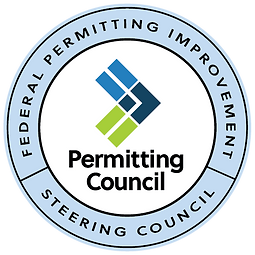

We started the project in an odd state of the agency because they were transitioning from FPISC (Federal Permitting Improvement Steering Council) to just the Permitting Council.


After a few rounds of discussion with the stakeholders we were able to settle on a color scheme that fit their desire to bring life to the Permitting Council.


I broke these pages down component by component and put them next to each other to help give a clearer picture as to what the differences are.


Information Architecture
When working on this project we ensured at every step that we were approaching this project in an agile format. The goal was to get a version 1 product out in the public and then enhance it going forward. The research and requirements definition up to this point was confirmed by stakeholders that this was good for a version 1 website while having some ideas for future launches in the back pocket.

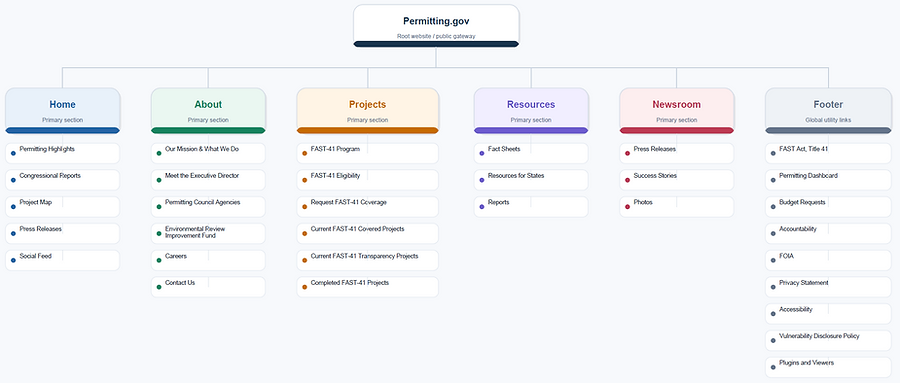
The stakeholders provided us with a site manifest document which was an excel sheet with all 300+ pages from the legacy site listed from a site crawl. They had reviewed every page to see if they wanted to bring that page and/or content over to the new website. This was crucial in helping decide what content was to be prioritized to the users.
We were able to use the information from this document to create a sitemap. We utilized ChatGPT to build this sitemap out as we needed to be quick with this phase of the project. Below is the finalized version of the sitemap.
DESIGN
Designing for Accessibility, Scalability, and Trust
The design phase translated the strategy into wireframes, prototypes, and reusable page patterns.
Low-fidelity wireframes were skipped for this project as we have already established what the site could look like to stakeholders in the define phase. Rather than showing the stakeholders more low-fidelity mockups that could waste precious project time, I used the pre-existing components in USWDS to build out the high-level pages within the information architecture including:
-
Landing Page (Home)
-
Projects
-
About
-
Resources
-
Newsroom


A major focus was scalability. Since the Permitting Council’s content needs were expected to grow, reusable components and consistent layouts were created to support future pages without requiring a full redesign.
After designing these initial pages, trends began to emerge as to what components are consistently used throughout the website. I began to work with the lead developer to break out these components into a library of reusable components that can be repurposed across the site. This is beneficial because it decreases the dev effort and increases familiarity with components to the user across the site. It is also nice for when the content managers are working on updating the site within Drupal as they can pick from a library of styled components that best fits their content.
Types of reusable components that we defined at this stage are:
-
Basic Content
-
Large Content
-
Form
-
Basic Table
-
Various Card Sections

Basic Content: Plain text and images on a page. Meant for small articles and information pages.

Large Content: Plain text and images condensed into expandable & collapsible accordions. Meant to reduce cognitive load on large information pages.
The lead developer and I presented the idea of reusable components to the project manager and he felt the idea was fantastic and went along with the stakeholders need for a quick launch. We got the green light to bring this approach to the stakeholders and prepared a presentation that helped translate dev and design language into a format that non-technical people could understand.
The presentation was quick and went over very well with the stakeholders. We could really see them light up when we spoke about how this would positively impact both their employees and the end user as well.
TESTING & ITERATIONS
Improving the Experience Through Feedback and Validation
Designs were reviewed regularly with stakeholders and development partners to identify areas that needed refinement.
Feedback helped simplify navigation labels, clarify content relationships, and improve how important resources were surfaced across the site. Several iterations were made to page structure, navigation flow, and content hierarchy before the final experience was approved.

Landing Page Version 1

Landing Page Final Version
RESULTS
Launching a Foundation for Long-Term Growth
The final website established the Permitting Council’s first public-facing digital presence and gave users a clearer way to access information about the agency, permitting resources, and infrastructure project coordination.
The project created a scalable foundation that could support future content, improve discoverability, and help the agency communicate its mission with greater clarity.
Proof of Concept
The early adoption of building the website with reusable components paid off immensely. Some components ended up being much more useful to the content managers, but overall they were able to quickly adapt to the preset components and utilize them all over the site.
By far the most used component was the basic content pages as it can be repurposed for any kind of page with a small amount of information such as:
FAST-41 Project Information


About the Permitting Council
Various News Articles


Resources for States
Not only did this approach make life easier for content managers, but it also ensured that we could keep consistent high accessibility compliance within Section 508 and WCAG. On launch we were able to maintain a 8.8/10 AIM accessibility score and it has not fallen from this number to this day.
FINAL THOUGHTS
Balancing Quality Work Within a Tight Timeline
What I Learned: This project reinforced the importance of creating alignment before moving into design. When working with complex government content and multiple stakeholders, the structure of the experience is just as important as the visual design.
What I'm Most Proud Of: I’m most proud of helping turn an undefined digital challenge into a clear, scalable experience. The final website gave a new federal agency a stronger public presence and created a foundation that could continue to grow with its mission.